


We instinctively understand the idea of inheritance. Of passing something down from one generation to another. It’s part of our society. Parents get it. Children get it.
Which is why this Disney scene hits. Here’s your future kingdom (avoid the Elephant’s Graveyard though, obviously).

Source: The Lion King
That’s why the popular response to inheritance tax changes is always so emotional – it feels like someone messing with how the world works.
Normally, though, we think about the impact of inheritance one or two generations ahead. Your kids, and maybe their kids.
But an inheritance can last a lot longer than that…
In the 15th century Florence was one of the richest cities in Europe; filled with bankers and merchants and goldsmiths, as well as second-hand linen dealers, sewer workers and street cleaners.
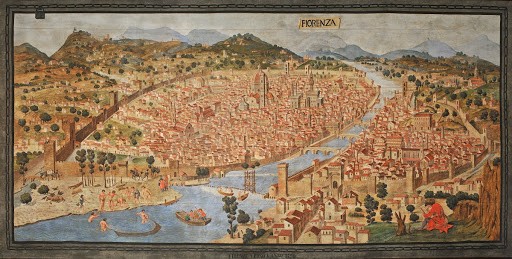
Source: Della Catena Map of Florence
In 1427, the Florentine government conducted a census of the 60,000 inhabitants. The aim was to collect taxes (of course), but it means we have a complete record of jobs, salaries, assets, and, importantly, names.
Italy has more surnames than almost any other country in the world. The top 100 Italian surnames represent just 7% of the population, whereas in England, the top hundred names cover a quarter of the population (Smith, Jones, Williams, Taylor, Brown are the top five).
So you can trace someone’s descendants far more easily down the years… which is exactly what a group of economists did.
They linked families from the 1427 census to people living in Florence today, to try and work out what happened to the city’s elite from six hundred years ago.
They found that even after twenty generations, wealth persisted. Wealthy families in 1427 in Florence, are still far more likely to be wealthy in Florence today:
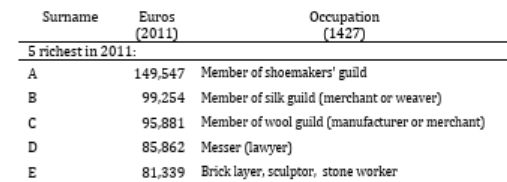
Source: Mocetti and Barone, 2018
Interestingly, inheritance wasn’t limited to wealth.
The researchers also found evidence that certain professions appeared to run in families, for far longer than expected. If your great-great-great-great-great-great-great-great-great-great-great-great-great-great-great-great-great-grandfather (give or take) was a Florentine Renaissance doctor, you were more likely to be a doctor too!
It turns out an inheritance isn’t just in the bank account.
Other things are passed down too. Knowledge. Skills. Family expectations and culture.
The money matters.
But perhaps the most interesting question isn’t how much wealth gets inherited. It’s what else gets handed down alongside it.
We spend a lot of time obsessing over inheriting financial capital. The Florentine evidence suggests we should spend a bit more time thinking about the human capital inheritance too – and hey, that’s not taxable!
*Disclaimer* This article is for general information only and does not constitute advice. The information is aimed at UK retail clients only.
All information is correct at the time of writing and is subject to change in the future. Data Source 7IM
 Production